cctm collettivo culturale tuttomondo Tiziano Vecellio (Pieve di Cadore, 1488–Venezia, 1576)
Tiziano Vecellio, noto semplicemente come Tiziano (Pieve di Cadore, 1488 – Venezia, 1576), è stato un pittore italiano, importante esponente della scuola veneziana.
Artista innovatore e poliedrico, maestro con Giorgione del tonalismo, fu uno dei pochi pittori italiani titolari di una vera e propria azienda, accorto imprenditore della bottega oltre che della sua personale produzione, direttamente a contatto con i potenti dell’epoca, suoi maggiori committenti.
Il rinnovamento della pittura di cui fu autore si basò, in alternativa al michelangiolesco «primato del disegno», sull’uso personalissimo del colore.
Genio e protagonista della pittura del Rinascimento nell’intero continente Europeo, Tiziano apportò, nella pittura rinascimentale, una rivoluzione artistica fatta di innovazioni: in particolare, usò la forza espressiva del colore materico e poi, nella maturità, abbandonò la spazialità bilanciata, il carattere solare e fastoso del colore del Rinascimento, assumendo il dinamismo proprio del manierismo e giocando con libertà nelle variazioni cromatiche.
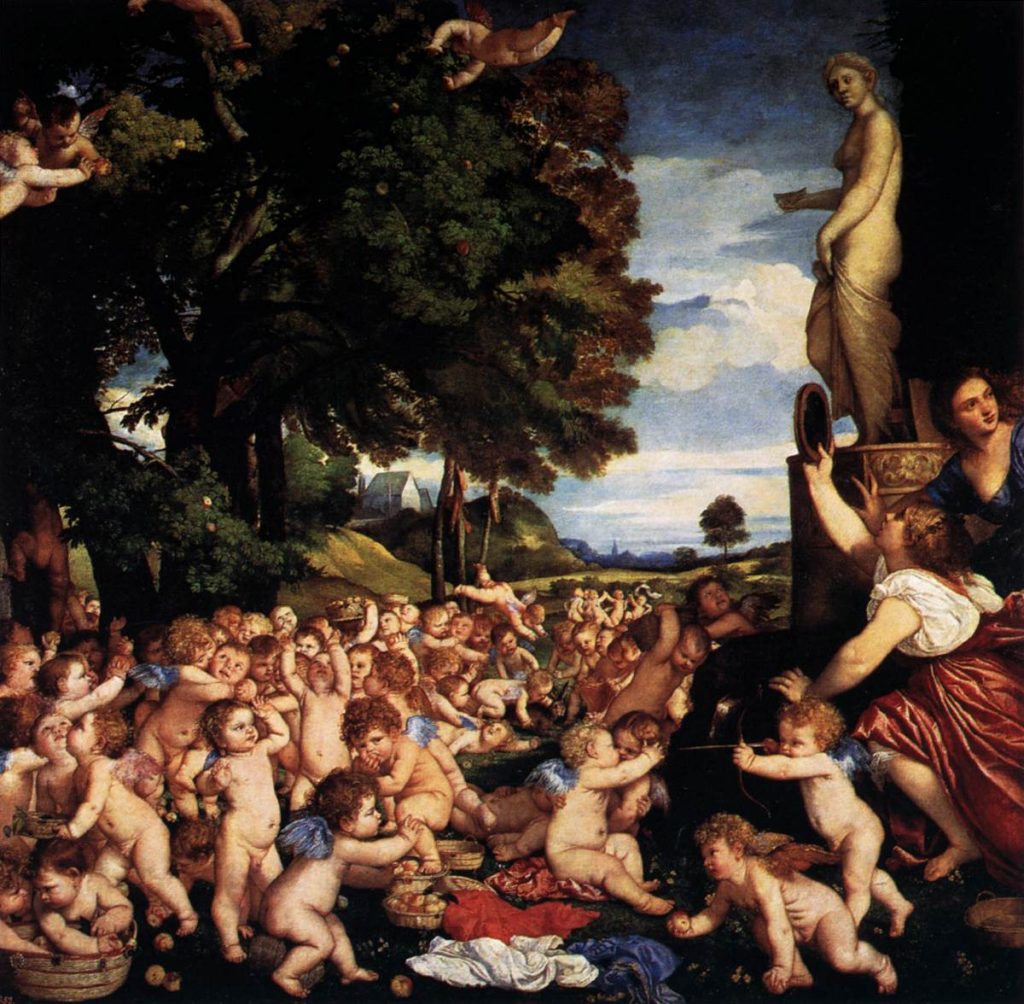
opera: Tiziano, Festa degli amorini,The Worship of Venus, 1518 – ubicazione: Museo del Prado, Madrid

Tiziano Vecellio, universally known as Titian (Pieve di Cadore, 1488 – Venice, 1576), was an Italian painter and one of the foremost figures of the Venetian School.
An innovative and remarkably versatile artist, Titian, together with Giorgione, was a leading master of tonalism. He was also among the very few Italian painters to operate a genuine artistic enterprise, skillfully managing both his workshop and his personal production. Through direct relationships with the most powerful rulers and patrons of his age, he established himself as one of the most sought-after artists of the Renaissance.
The transformation of painting that he spearheaded was founded on a highly personal use of color, offering an alternative to Michelangelo’s celebrated “primacy of drawing” (primato del disegno).
A towering genius and a central protagonist of Renaissance painting across Europe, Titian revolutionized the art of his time through a series of groundbreaking innovations. Most notably, he exploited the expressive potential of richly textured color and, in his later years, moved beyond the balanced spatial harmony and luminous splendor characteristic of the High Renaissance. Instead, he embraced the dynamism associated with Mannerism, experimenting with unprecedented freedom in his handling of color and tonal variation.
