cctm collettivo culturale tuttomondo Toti Scialoja (Italia)
Grazie a una lucciola
che te la illumina
se scosti i riccioli
ti vedo l’anima.
Thanks to a firefly
that lights it for you,
if you brush aside your curls
I can see your soul.
Toti Scialoja
da Versi del tempo perso, Einaudi, 2009
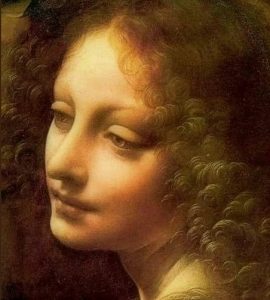
opera: Leonardo da Vinci, La Vergine delle Rocce, 1483 – dettaglio

Toti Scialoja (Roma, 1914 – Roma, 1998), è stato un pittore e poeta italiano.
Interrotti gli studî giuridici, dal 1937 si dedicò alla pittura: nel 1939 un suo disegno viene segnalato dalla giuria della Quadriennale di Roma e nel 1940 realizza la sua prima personale a Genova. Durante la guerra, e prima di partecipare alla Resistenza, espone a Roma con Giulio Turcato ed Emilio Vedova. Dopo una prima esperienza espressionista, legata alla scuola romana, giunse dal 1955 all’astrattismo e sperimentò tecniche diverse, dal dripping all’uso di stracci impregnati di colore, dallo stampaggio agli inserti materici. Le sue opere, strutturate negli anni Settanta in elementi geometrici ritmicamente scanditi, dopo il 1982 riproposero un linguaggio di matrice gestuale. Direttore (1982) dell’Accademia di Belle arti di Roma, dal 1988 realizzò anche sculture.
Parte integrante della sua ricerca fu il lavoro per il teatro, al quale si dedicò collaborando con scrittori, musicisti, registi e coreografi d’avanguardia (V. Pandolfi, A. Miloss, R. Vlad). Tra i suoi allestimenti si ricordano: L’opera dello straccione di J. Gay (1943, proibita dalle autorità fasciste); i balletti Marsia di L. Dallapiccola (1948) e Il principe di legno di B. Bartók (1950); Traumdeutung di E. Sanguineti (1964), Il Ratto di Proserpina di Rosso di San Secondo (1986).
Oltre che in prose liriche (I segni della corda, 1952), la sua raffinata vocazione poetica si espresse in numerose raccolte di versi (alcune da lui stesso illustrate), ricche di umorismo, giochi verbali e nonsense (Amato topino caro, 1971; Scarse serpi, 1983; Le sillabe della Sibilla, 1988; I violini del diluvio, 1991; ecc.).
Toti Scialoja (Rome, 1914 – Rome, 1998) was an Italian painter and poet.
After abandoning his studies in law, he devoted himself to painting from 1937 onward. In 1939 one of his drawings was singled out by the jury of the Rome Quadriennale, and in 1940 he held his first solo exhibition in Genoa. During the war, and before joining the Resistance, he exhibited in Rome together with Giulio Turcato and Emilio Vedova. After an initial Expressionist phase linked to the Roman School, from 1955 he moved toward abstraction, experimenting with a wide range of techniques, from dripping to the use of paint-soaked rags, from stamping to the inclusion of material elements. In the 1970s his works were structured around rhythmically articulated geometric elements; after 1982 they returned to a gestural language. Appointed director of the Academy of Fine Arts in Rome in 1982, from 1988 onward he also produced sculptures.
An integral part of his artistic research was his work for the theatre, to which he devoted himself through collaborations with avant-garde writers, musicians, directors, and choreographers (V. Pandolfi, A. Miloss, R. Vlad). Among his stage designs are The Beggar’s Opera by J. Gay (1943, banned by the Fascist authorities); the ballets Marsyas by L. Dallapiccola (1948) and The Wooden Prince by B. Bartók (1950); Traumdeutung by E. Sanguineti (1964); and The Rape of Proserpina by Rosso di San Secondo (1986).
In addition to lyrical prose (The Signs of the String, 1952), his refined poetic vocation found expression in numerous collections of verse (some illustrated by the author himself), rich in humor, wordplay, and nonsense (Beloved Dear Little Mouse, 1971; Sparse Serpents, 1983; The Sibyl’s Syllables, 1988; The Violins of the Flood, 1991; etc.).
_