cctm collettivo culturale tuttomondo Salvatore Quasimodo Uomo del mio tempo
Uomo del mio tempo di Salvatore Quasimodo (Modica, 1901 – Napoli, 1968)
Sei ancora quello della pietra e della fionda,
uomo del mio tempo. Eri nella carlinga,
con le ali maligne, le meridiane di morte,
t’ho visto – dentro il carro di fuoco, alle forche,
alle ruote di tortura. T’ho visto: eri tu,
con la tua scienza esatta persuasa allo sterminio,
senza amore, senza Cristo. Hai ucciso ancora,
come sempre, come uccisero i padri, come uccisero
gli animali che ti videro per la prima volta.
E questo sangue odora come nel giorno
Quando il fratello disse all’altro fratello:
«Andiamo ai campi». E quell’eco fredda, tenace,
è giunta fino a te, dentro la tua giornata.
Dimenticate, o figli, le nuvole di sangue
Salite dalla terra, dimenticate i padri:
le loro tombe affondano nella cenere,
gli uccelli neri, il vento, coprono il loro cuore.
da Giorno dopo giorno, A. Mondadori, 1947
Man of my time by Salvatore Quasimodo (Modica, 1901 – Napoli, 1968)
You are still a man of the sling and of the stone,
man of my time. You were in the cockpit,
with the malignant wings, the dials of death,
I saw you – in the chariot of fire, on the gallows,
at the breaking wheel. I saw you: it was you,
with your exact science wooing slaughter,
without love, without Christ. You killed again,
as always, as your fathers killed, as those animals
that saw you for the first time killed.
And this blood smells of the blood that day
When one brother said to another brother:
“Let’s go to the fields.” And that cold echo, dogged,
passed down to you, within your day.
Forget, oh sons, the clouds of blood
Lifted from the earth, forgotten by your fathers:
their tombs sink into the ashes,
the black vultures, the wind, cover their hearts.
_
traduzione: Matilda Colarossi
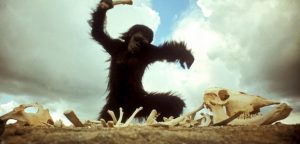
immagine: fotogramma da film 2001 Odissea nello spazio, regia di Stanley Kubrick, 1968

Salvatore Quasimodo (Modica, 1901 – Napoli, 1968) è stato un poeta e traduttore italiano.
Considerato uno dei principali esponenti della corrente poetica dell’ermetismo, è stato inoltre traduttore di molti classici greci e delle opere teatrali di Molière e Shakespeare.
Nel 1959 è stato insignito del Premio Nobel per la Letteratura.
La fase più creativa dell’opera poetica di Quasimodo si può far risalire ad Acque e terre (1930), Oboe sommerso (1932), e a Ed è subito sera (1942).
Salvatore Quasimodo (August 20, 1901 – June 14, 1968) was an Italian poet and translator.
In 1959, he won the Nobel Prize in Literature “for his lyrical poetry, which with classical fire expresses the tragic experience of life in our own times”.
Along with Giuseppe Ungaretti and Eugenio Montale, he was one of the foremost Italian poets of the 20th century.
Traditional literary critique divides Quasimodo’s work into two major periods: the hermetic period until World War II and the post-hermetic era until his death. Although these periods are distinct, they are to be seen as a single poetical quest. This quest or exploration for a unique language took him through various stages and various modalities of expression.
As an intelligent and clever poet, Quasimodo used a hermetical, “closed” language to sketch recurring motifs like Sicily, religion and death. Subsequently, the translation of authors from Roman and Greek Antiquity enabled him to extend his linguistic toolkit. The disgust and sense of absurdity of World War II also had its impact on the poet’s language … keep on reading Wikipedia
_
cctm collettivo culturale tuttomondo Salvatore Quasimodo Uomo del mio tempo
