cctm collettivo culturale tuttomondo Alfredo Biagini (Italia)
Alfredo Biagini (Roma, 1886 – Roma, 1952) è stato uno scultore, ceramista e decoratore d’interni italiano.
Alfredo Biagini frequenta l’Accademia di Belle Arti di Roma ma abbandona gli nel 1909 per trasferirsi a Parigi. Durante il primo conflitto mondiale lavora a villa Strohl-Fern a Roma, acquisendo uno stile decorativo secessionista. La sua fama crebbe grazie ad alcune mostre e alla collaborazione con Marcello Piacentini, assieme al quale esegue decorazioni per teatri e sculture in marmo. Biagini esplora anche la scultura ritrattistica, aggiungendo elementi floreali come nella Testa di bambina del 1918.Negli anni ’20 e ’30 l’artista realizza opere con rami sbalzati in uno stile fortemente influenzato dall’Art Déco. La sua abilità maggiore si manifesta soprattutto nell’impiego della ceramica. Partecipa attivamente a mostre nazionali e internazionali, esponendo alle Biennali di Venezia e alle Quadriennali romane. Negli ultimi anni di vita si dedica all’arte religiosa e vince un concorso per la porta bronzea della basilica di San Pietro in Vaticano insieme a Giacomo Manzù.
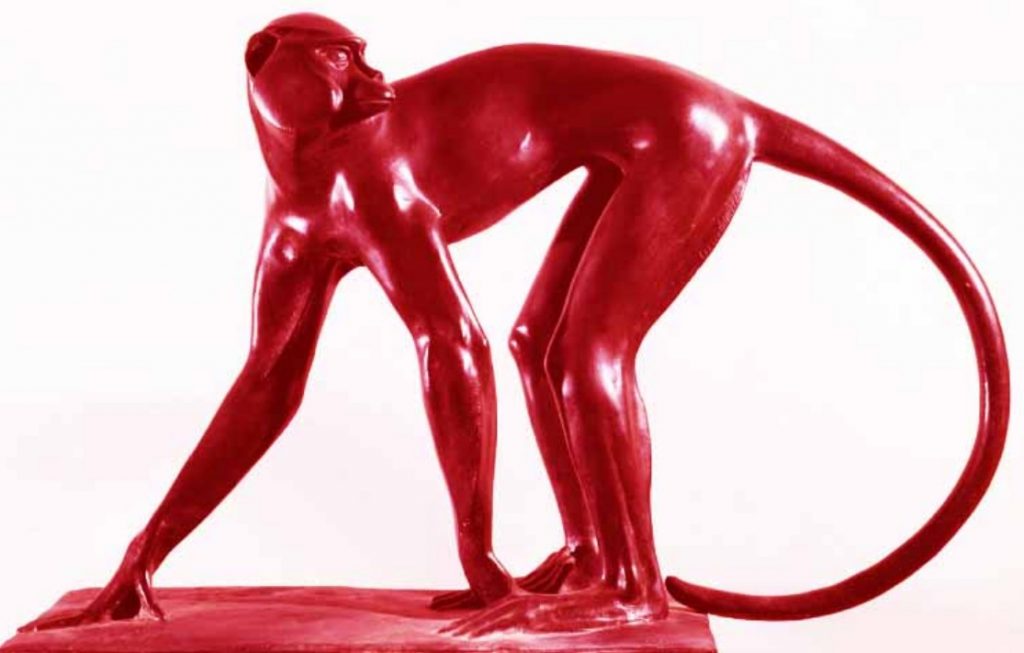
opera: Alfredo Biagini, Cercopiteco rosso, 1929

Alfredo Biagini (Rome, 1886–1952) was an Italian sculptor, ceramic artist, and interior decorator.
Biagini studied at the Academy of Fine Arts in Rome before leaving in 1909 to settle in Paris. During the First World War, he worked at Villa Strohl-Fern in Rome, where he developed a decorative language informed by the Secessionist movement. His reputation grew through a series of exhibitions and through his collaboration with the architect Marcello Piacentini, with whom he produced theatrical decorations and marble sculptures.
Alongside his decorative work, Biagini explored portrait sculpture, often enriching his compositions with floral motifs, as exemplified by Head of a Young Girl (1918). Throughout the 1920s and 1930s, he created works featuring repoussé branches and ornamental forms strongly influenced by the Art Deco aesthetic. His most distinctive achievements, however, were in the field of ceramics, where he demonstrated exceptional technical and artistic mastery.
An active participant in both national and international exhibitions, Biagini exhibited regularly at the Venice Biennale and the Rome Quadriennale. In the final years of his career, he turned increasingly toward religious art and, together with Giacomo Manzù, won the competition for the design of a bronze door for St Peter’s Basilica in Vatican City.
_
