cctm collettivo culturale tuttomondo Gio Ponti Concattedrale di Taranto
Consacrata da Mons. Guglielmo Motolese il 6 dicembre del 1970, la Concattedrale di Taranto dedicata alla “Gran Madre di Dio”, è stata l’ultima e forse più bella opera di Gio Ponti.
Il desiderio di dotare la città di un nuovo luogo di culto cristiano nelle aree che più di tutte erano protagoniste della rinascita urbanistica di quel periodo, si era già fatta presente nei pensieri dell’Arcivescovo Motolese a partire dai primi anni sessanta del novecento.
Per l’esecuzione del progetto fu chiamato il noto architetto Gio Ponti che decise di articolare la struttura, in analogia con le antiche cattedrali italiane, in due parti: una navata contenuta in un corpo basso ed un alto campanile.
La travagliata genesi progettuale portò l’architetto ad elaborare ben quattro distinte versioni del disegno prima di arrivare a quello definitivo. Dallo studio del ricco epistolario tra il designer e l’Arcivescovo, si evince chiaramente come Ponti abbia vissuto l’incarico quale un vero e proprio percorso di fede e riflessione religiosa prima che tecnico, una riflessione matura e consapevole nella quale l’unica preoccupazione era quella di offrire alla città un’architettura che fosse a servizio della fede e della liturgia.
Gli anni che portarono al disegno definitivo furono quelli del Concilio Vaticano Secondo durante il quale si stava approntando la riforma liturgica che avrebbe cambiato sensibilmente il modo di celebrare la Messa e per Ponti fu questa una vera e propria sfida: costruire una Chiesa già pronta secondo le nuove disposizioni.
La struttura, pur presentandosi quale una lettura moderna dei canoni classici, andò via via arricchendosi di novità strutturali ed architettoniche che la portarono a definirsi quale un vero e proprio unicum.
Lo stretto rapporto tra la città di Taranto ed il mare è facilmente evidenziato per l’idea alla base dell’opera: Una nave che doveva potersi specchiare nelle placide acque di tre vasche poste di fronte a lei con una vela al posto del campanile.
La vela campanaria è definita da due pareti in cemento armato bianco alte quarantuno metri, larghe ventidue e traforate da ottanta finestre esagonali e rettangolari, incastrate ai lati tra due strette torri campanarie.
La scelta delle finestre aperte sul cielo fu spiegata dallo stesso Ponti: “Ho pensato: due facciate. Una, la minore, salendo la scalinata, con le porte per accedere alla chiesa. L’altra, la maggiore, accessibile solo allo sguardo e al vento: una facciata per l’aria, con ottanta finestre aperte sull’immenso, che è la dimensione del mistero… Altrimenti dove si dovrebbero sedere gli angeli?”.
Giovanni “Gio” Ponti (Milano, 1891 – Milano, 1979) è stato un architetto, designer, artista e scrittore italiano, considerato una figura chiave nello sviluppo dell’architettura moderna e del design.
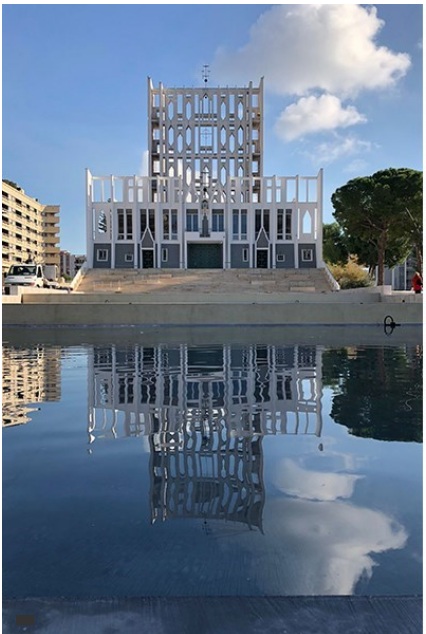
fotografia: Concattedrale Gran Madre di Dio, Taranto by Fernando Errico – fair use

Consecrated by Monsignor Guglielmo Motolese on 6 December 1970, the Co-Cathedral of Taranto dedicated to the “Great Mother of God” is the last—and perhaps the most beautiful—work by the architect Gio Ponti.
The desire to provide the city with a new place of Christian worship in the areas most affected by the urban renewal of that period had already emerged in the thoughts of Archbishop Motolese in the early 1960s.
The renowned architect Gio Ponti was commissioned to carry out the project. Drawing inspiration from the layout of ancient Italian cathedrals, he conceived the structure as composed of two distinct elements: a nave contained within a low building and a tall bell tower.
The complex design process led Ponti to produce four different versions of the project before arriving at the final one. The extensive correspondence between the architect and the Archbishop clearly shows that Ponti experienced the commission as a true journey of faith and spiritual reflection even before it became a technical undertaking. It was a mature and conscious reflection in which his sole concern was to offer the city an architecture capable of serving faith and the liturgy.
The years that led to the definitive design coincided with the period of the Second Vatican Council, when the liturgical reform that would profoundly change the way Mass was celebrated was being prepared. For Ponti this represented a genuine challenge: to design and build a church already conceived in accordance with the new liturgical directives.
While presenting itself as a modern interpretation of classical principles, the structure gradually incorporated structural and architectural innovations that ultimately made it a truly unique work.
The close relationship between the city of Taranto and the sea is clearly expressed in the concept underlying the project: a ship reflected in the calm waters of three pools placed before it, with a sail in place of the traditional bell tower.
The bell “sail” consists of two white reinforced-concrete walls forty-one metres high and twenty-two metres wide, pierced by eighty hexagonal and rectangular openings and set between two narrow bell towers.
Ponti himself explained the choice of windows opening onto the sky:
“I imagined two facades. One, the smaller one, reached by climbing the staircase, with the doors giving access to the church. The other, the larger one, accessible only to the gaze and the wind: a facade for the air, with eighty windows opening onto the immensity, which is the dimension of mystery… Otherwise, where would the angels sit?”
Giovanni “Gio” Ponti (Milan, 1891 – Milan, 1979) was an Italian architect, designer, artist, and writer, considered a key figure in the development of modern architecture and design.
_