cctm collettivo culturale tuttomondo Marino Marini (Italia)
Marino Marini (Pistoia, 1901 – Viareggio, 1980) è stato uno scultore, pittore e incisore italiano.
Si forma all’Accademia di Belle Arti di Firenze, dove studia pittura, scultura e incisione. Nei primi anni Venti la sua attività è soprattutto pittorica, ma dal 1922 la scultura diventa il centro della sua ricerca, pur senza abbandonare il disegno e la grafica.
La sua opera si costruisce attorno a pochi grandi temi: il cavallo e il cavaliere, le Pomone, le figure del circo e del teatro, i ritratti. Il gruppo equestre, in particolare, diventa il suo soggetto più riconoscibile: attraverso una progressiva stilizzazione, Marini trasforma il binomio uomo-cavallo in un’immagine quasi mitica, carica di tensione simbolica. Le Pomone, figure femminili nude e monumentali, incarnano invece un’idea di fertilità e di archetipo femminile.
Nel 1942 ottiene la cattedra di scultura all’Accademia di Brera a Milano, dove insegna per molti anni. La sua fama cresce in Italia e all’estero: sue opere entrano in collezioni pubbliche e private di prestigio e gli vengono dedicati musei monografici a Pistoia e Firenze.
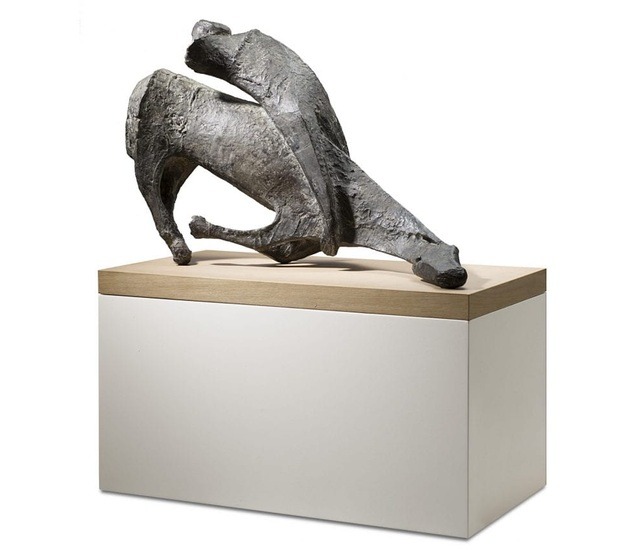
opera: Marino Marini, Studio per Miracolo, 1954 – ubicazione: Museo Marino Marini, Firenze

Marino Marini (Pistoia, 1901 – Viareggio, 1980) was an Italian sculptor, painter, and printmaker.
He trained at the Academy of Fine Arts in Florence, where he studied painting, sculpture, and printmaking. During the early 1920s, his artistic practice was primarily devoted to painting; from 1922 onwards, however, sculpture became the central focus of his research, while drawing and graphic work remained an integral part of his practice throughout his career.
Marini’s oeuvre revolves around a number of recurring and deeply resonant themes: the horse and rider, the Pomonas, figures drawn from the worlds of the circus and theatre, and portraiture. The equestrian figure, in particular, became the defining subject of his art. Through a gradual process of simplification and formal distillation, Marini transformed the human-and-horse motif into an almost mythical image, charged with profound symbolic tension. His Pomonas—monumental female nudes—embody, in turn, an archetypal vision of femininity, fertility, and the generative forces of nature.
In 1942, Marini was appointed Professor of Sculpture at the Brera Academy in Milan, where he would teach for many years. His reputation soon extended well beyond Italy, and his work entered numerous prestigious public and private collections. His artistic legacy is further reflected in the museums dedicated to his work in Pistoia and Florence.
_
cctm collettivo culturale tuttomondo Marino Marini (Italia)
