cctm collettivo culturale tuttomondo Marino Piazzolla (Italia)
di Marino Piazzolla (San Ferdinando di Puglia, 1910 – Roma, 1985)
E a guardarli bene, ad odorarli, i fiori conservano, nella loro brevissima giornata terrena, una traccia vaga, indefinibile di un mondo che, essendo misterioso, apre il cuore dell’uomo alla speranza; ma soprattutto all’amore, che è insieme verità e bellezza della vita. Ed è così che i fiori c’insegnano a sorridere.
da I fiori c’insegnano a sorridere, Ghelfi, 1973
by Marino Piazzolla (San Ferdinando di Puglia, 1910 – Rome, 1985)
And when one truly looks at them, truly breathes them in, flowers preserve—within their very brief earthly day—a faint, indefinable trace of a world which, in being mysterious, opens the human heart to hope; but above all to love, which is at once the truth and the beauty of life. And thus it is that flowers teach us how to smile.
from Flowers Teach Us How to Smile, Ghelfi, 1973
_
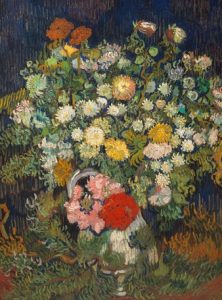
opera: Vincent van Gogh, Bouquet di fiori in un vaso, 1890

Marino Piazzolla (San Ferdinando di Puglia, 1910 – Roma, 1985) è stato un poeta e scrittore italiano, formatosi in Francia dove entrò in contatto con figure come André Gide, Paul Valéry e i surrealisti.
La sua vita fu segnata dalla precoce perdita dei genitori, dal trasferimento a Parigi nel 1931 e da un’intensa attività letteraria tra lirica, prosa e critica, con riconoscimenti come il Premio Etna-Taormina nel 1951 e il Premio Pisa nel 1964.
Studiò alla Sorbona, laureandosi in filosofia nel 1938 con una tesi su poetiche da Aristotele a Brémond, e collaborò a riviste come L’Âge Nouveau e La Phalange, pubblicando in francese raccolte come Horizons perdus e Caravanes. Tornato in Italia nel 1940, si legò a Vincenzo Cardarelli de La Fiera Letteraria, fondò la rivista Narciso (1946-1947) e insegnò storia e filosofia nei licei romani.
Tra le sue pubblicazioni principali figurano poemetti come Lettere della sposa demente (1952) e Esilio sull’Himalaya (1953), raccolte liriche come Elegie doriche (1951) e Pietà della notte (1957), oltre a opere tarde come Agalmata (1984).
Marino Piazzolla (San Ferdinando di Puglia, 1910 – Rome, 1985) was an Italian poet and writer who received his formative education in France, where he came into contact with figures such as André Gide, Paul Valéry, and the Surrealists.
His life was marked by the early loss of his parents, his move to Paris in 1931, and an intense literary activity spanning lyric poetry, prose, and criticism. He received major recognitions, including the Etna-Taormina Prize in 1951 and the Pisa Prize in 1964.
He studied at the Sorbonne, earning a degree in philosophy in 1938 with a thesis on poetic theories from Aristotle to Brémond, and contributed to journals such as L’Âge Nouveau and La Phalange, publishing poetry collections in French such as Horizons perdus and Caravanes. Returning to Italy in 1940, he became associated with Vincenzo Cardarelli and La Fiera Letteraria, founded the journal Narciso (1946–1947), and taught history and philosophy in Roman secondary schools.
Among his principal works are poetic sequences such as Letters of the Mad Bride (1952) and Exile on the Himalayas (1953); lyric collections including Doric Elegies (1951) and Pity of the Night (1957); as well as later works such as Agalmata (1984).
_
