cctm collettivo culturale tuttomondo Guido Balsamo Stella (Italia)
Guido Balsamo Stella (Torino, 1882 – Asolo, 1941) è stato un pittore e incisore italiano, grande innovatore della tecnica dell’incisione su vetro.
La sua formazione iniziale non è documentata in modo completo, ma agli inizi del Novecento ottenne uno studio a Ca’ Pesaro, a Venezia. In seguito studiò alle Accademie di Monaco e di Stoccolma, entrando in contatto con ambienti artistici mitteleuropei e nordici.
La sua prima attività si svolse tra Germania e Svezia, dove lavorò come pittore, decoratore ad affresco e incisore. A Stoccolma realizzò incisioni per l’industria del ferro, affreschi per la ditta Cornelius e grandi tele con la Leggenda di Orfeo per la villa dell’editore Sijthoff. Sempre in Svezia conobbe da vicino la produzione dei vetri incisi di Orrefors, esperienza decisiva per il suo orientamento successivo.
Tornato in Italia, si dedicò soprattutto all’incisione, agli ex libris, all’illustrazione del libro e alla scultura in legno. I maggiori riconoscimenti gli vennero però dall’incisione su vetro, tecnica che contribuì a diffondere in Italia e che lo rende una figura importante per la rinascita dell’arte vetraria, in particolare nell’area di Murano.
Dal 1936 al 1941 ha diretto l’Istituto Statale d’Arte di Venezia.
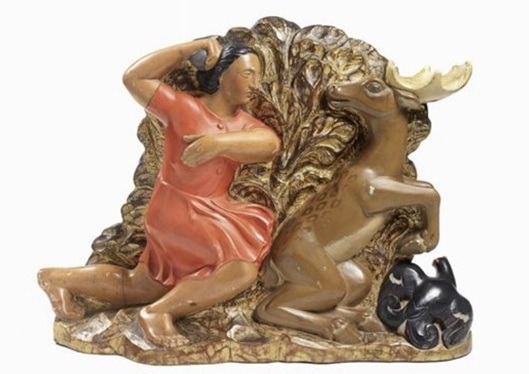
opera: Guido Balsamo Stella, Diana cacciatrice, Diana the Huntress, 1925 – scultura in vetro policroma, polychrome glass sculpture – collezione privata

Guido Balsamo Stella (Turin, 1882 – Asolo, 1941) was an Italian painter and printmaker, and a pioneering figure in the art of glass engraving.
Although the details of his early artistic training remain only partially documented, at the beginning of the twentieth century he was granted a studio at Ca’ Pesaro in Venice. He subsequently studied at the Academies of Munich and Stockholm, where he came into contact with the artistic circles of Central and Northern Europe.
His early career developed between Germany and Sweden, where he worked as a painter, fresco decorator, and engraver. In Stockholm, he produced engraved designs for the iron industry, frescoes for the Cornelius company, and a series of monumental canvases illustrating the Legend of Orpheus for the villa of the publisher Sijthoff. While in Sweden, he also became closely acquainted with the engraved glass produced by Orrefors, an experience that proved decisive in shaping his later artistic direction.
After returning to Italy, he devoted himself primarily to printmaking, the design of ex libris, book illustration, and wood sculpture. His greatest acclaim, however, came through his work in glass engraving. He played a pivotal role in establishing and promoting this technique in Italy and is regarded as one of the key figures in the revival of Italian glass art, particularly within the Murano tradition.
From 1936 until his death in 1941, he served as Director of the State Institute of Art of Venice.
_
