cctm collettivo culturale tuttomondo Bice Lazzari (Italia)
“L’arte è un segno d’amore che l’uomo cerca di donare agli altri nella ricerca continua di scoprire un rapporto vitale tra vita sociale, comportamento umano, morale e culturale.” Bice Lazzari
Bice Lazzari (Venezia, 1900 – Roma, 1981) è stata una pittrice italiana.
Agli esordi della carriera, durante il periodo fascista, deve impegnare il suo talento nelle arti applicate e nel design, pur dipingendo paesaggi e figure, perché per «una signorina di buona famiglia» non era ancora il tempo di andare per il mondo con una tela sottobraccio.
Disegna borse, cinture, stoffe e arredi con cui si mantiene economicamente, senza mai smettere di indagare stili e studiare gli orientamenti espressivi delle arti moderne, prediligendo tendenze geometriche estratte e collaborando coi maggiori architetti degli anni ‘30.
Nel dopoguerra, poco prima degli anni ’50, riprende in mano i pennelli, ma questa volta lo fa da artista, in maniera totalizzante, slegata da ogni vincolo di committenza. Ostinatamente dipinge, con tratti corposi e consistenti, grazie all’uso sperimentale di materiali come colle, sabbie e tempere miste.
La pittura di questa fase è materica, strabordante di colore come una necessità da urlare al mondo. Vent’anni dopo, i tratti delle sue pennellate si sciolgono e fluidificano in acrilici con cui esplora l’astratto composto da segni ripetuti, tele monocrome, partiture di linee rette e curve, cerchi e quadrati. In queste opere della maturità raggiunge proporzioni formali e scandisce lo spazio della tela al ritmo di una partitura.
In una stretta relazione fra spazio, tempo e misura. Ovvero nell’armonia dell’equilibrio che si raggiunge solo quando si fa caparbiamente ciò che si è.
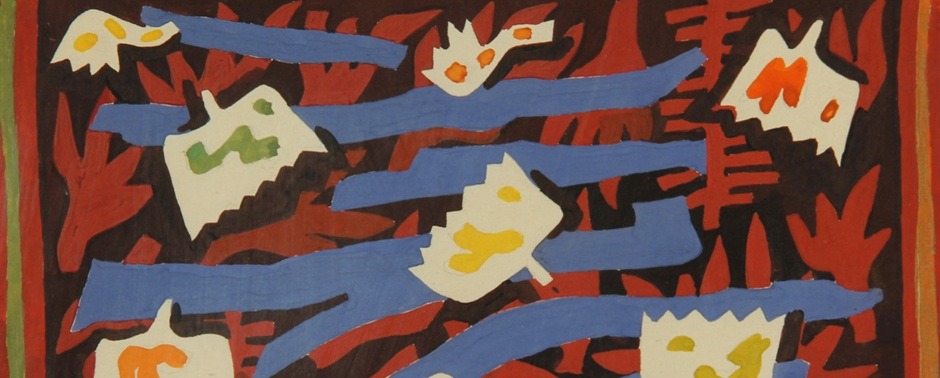
opera: Bice Lazzari, L/30 (1945), courtesy Archivio Bice Lazzari

Bice Lazzari (Venice, 1900 – Rome, 1981) was an Italian painter.
At the beginning of her career, during the Fascist era, she found herself channeling her talent into the applied arts and design. Although she continued to paint landscapes and figures, the time had not yet come for “a young woman from a respectable family” to travel the world with a canvas tucked under her arm.
To support herself, she designed handbags, belts, textiles, and furnishings, all the while pursuing an independent exploration of artistic languages and the evolving directions of modern art. Drawn to geometric abstraction, she collaborated with some of Italy’s leading architects throughout the 1930s.
In the years following the Second World War, on the eve of the 1950s, she returned to painting. This time, however, she embraced it as a fully committed artistic practice, free from the constraints of commissioned work. With unwavering determination, she developed a bold and tactile painterly language, experimenting with materials such as glue, sand, and mixed tempera.
The works of this period are intensely material, overflowing with colour as if driven by an urgent need for expression. Two decades later, her brushwork became lighter and more fluid. Working in acrylic, she explored an abstract vocabulary built from repeated marks, monochrome surfaces, and rhythmic sequences of straight and curved lines, circles, and squares. In these mature works, she achieved a remarkable formal clarity, articulating the space of the canvas with the measured cadence of a musical score.
A profound dialogue between space, time, and measure emerges from this practice—an expression of the harmony and balance that can only be attained through the steadfast pursuit of one’s true nature.
_
cctm collettivo culturale tuttomondo Bice Lazzari (Italia)
