cctm collettivo culturale tuttomondo Giovanni Segantini (Italia)
Giovanni Segantini (Arco, 1858 – monte Schafberg, 1899) è stato un pittore italiano, tra i massimi esponenti del divisionismo.
Pittore delle montagne, nei suoi quadri i soggetti protagonisti sono i paesaggi, i villaggi, le malghe, il bestiame ed i riti quotidiani delle genti di montagna.
Segantini esordisce come pittore verista con opere caratterizzate da una pennellata materica e corposa, poi si avvicina al divisionismo, già riscontrabile nella seconda versione del dipinto Traghetto all’Ave Maria del 1886-88, e dopo il 1890 le sue opere assumono anche valenze simboliste, come nelle opere: L’angelo della vita e L’amore alla fonte della vita, per approdare infine ad un suo stile personale.
La tecnica divisionista consiste nell’applicare sottili pennellate di colori a olio puri, non mescolati, molto ravvicinate a pennellate di colori complementari. E’ una tecnica pittorica che permette un incremento della luminosità del dipinto e si rivela particolarmente adatta per raffigurare le montagne e la loro luce intensa. Segantini dietro suggerimento di Vittore Grubicy la sperimenta, si rende immediatamente conto della potenzialità di tale tecnica e la adotta per le sue rappresentazioni artistiche.
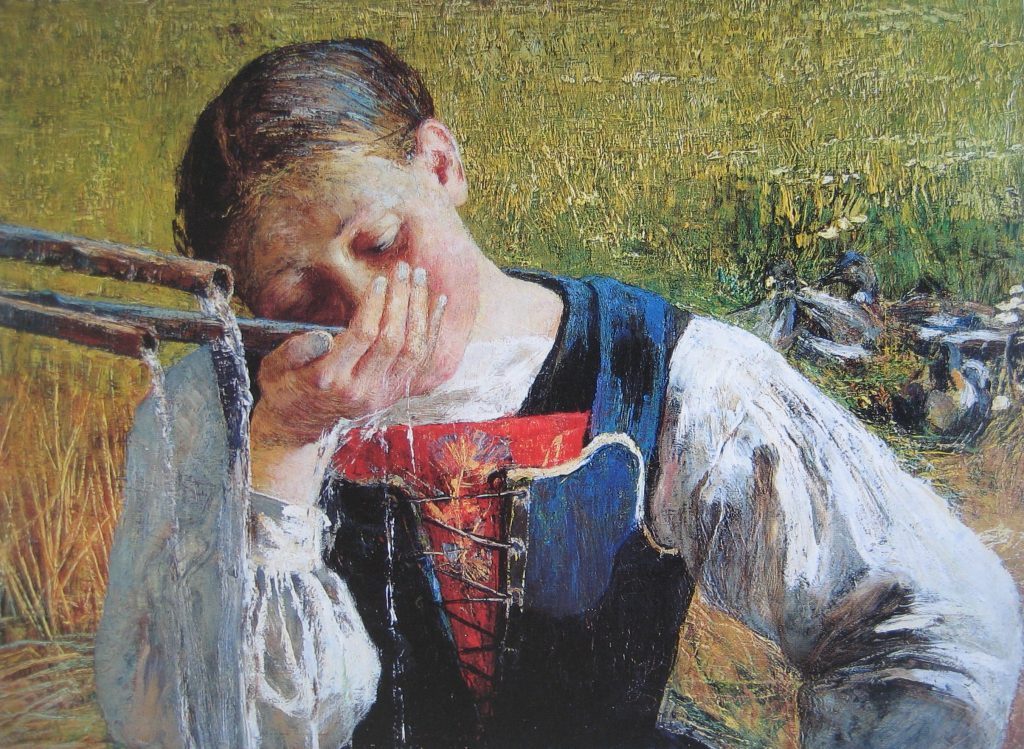
opera: Giovanni Segantini, Bevendo alla fontana, 1887 – ubicazione Museo Segantini, St. Moritz

Giovanni Segantini (Arco, 1858 – Mount Schafberg, 1899) was an Italian painter and one of the foremost exponents of Divisionism.
Renowned as the painter of the Alps, Segantini devoted much of his work to mountain landscapes. His paintings portray alpine villages, high mountain pastures, livestock, and the everyday life and traditions of mountain communities, capturing both the physical beauty and the spiritual essence of the alpine world.
Segantini began his career as a Realist painter, creating works distinguished by their rich, textured brushwork. He gradually embraced Divisionism, a transition already evident in the second version of The Ferry Crossing at the Ave Maria (Traghetto all’Ave Maria, 1886–1888). From around 1890 onwards, his paintings also acquired a strong Symbolist dimension, exemplified by masterpieces such as The Angel of Life (L’angelo della vita) and Love at the Fountain of Life (L’amore alla fonte della vita), before evolving into a highly personal and unmistakable artistic language.
The Divisionist technique consists of applying fine strokes of pure, unmixed oil paint alongside complementary colours rather than blending pigments on the palette. This optical method enhances the luminosity and vibrancy of the image, making it particularly effective for depicting the brilliant light and atmosphere of the Alpine landscape. Encouraged by the art dealer and critic Vittore Grubicy, Segantini experimented with the technique, quickly recognised its expressive potential, and adopted it as a defining element of his mature style.
_
